Winter Care for Stamped Concrete Driveways in Red Deer, Alberta
Red Deer averages 40+ freeze-thaw cycles per winter and chinook temperature swings of 30°C in 24 hours. Stamped concrete driveways handle this harder than plain concrete because the release agents and sealers used in the stamping process create a surface layer that is more vulnerable to de-icing chemicals and moisture infiltration. This guide covers exactly what to do — and what not to do — to protect your investment through every Alberta winter.
Need a professional assessment or spring resealing? Contact Gilbert Concrete for a free inspection in Red Deer, Lacombe, Blackfalds and Central Alberta. Call (403) 391-9489.
Why Stamped Concrete Needs More Winter Protection Than Plain Concrete
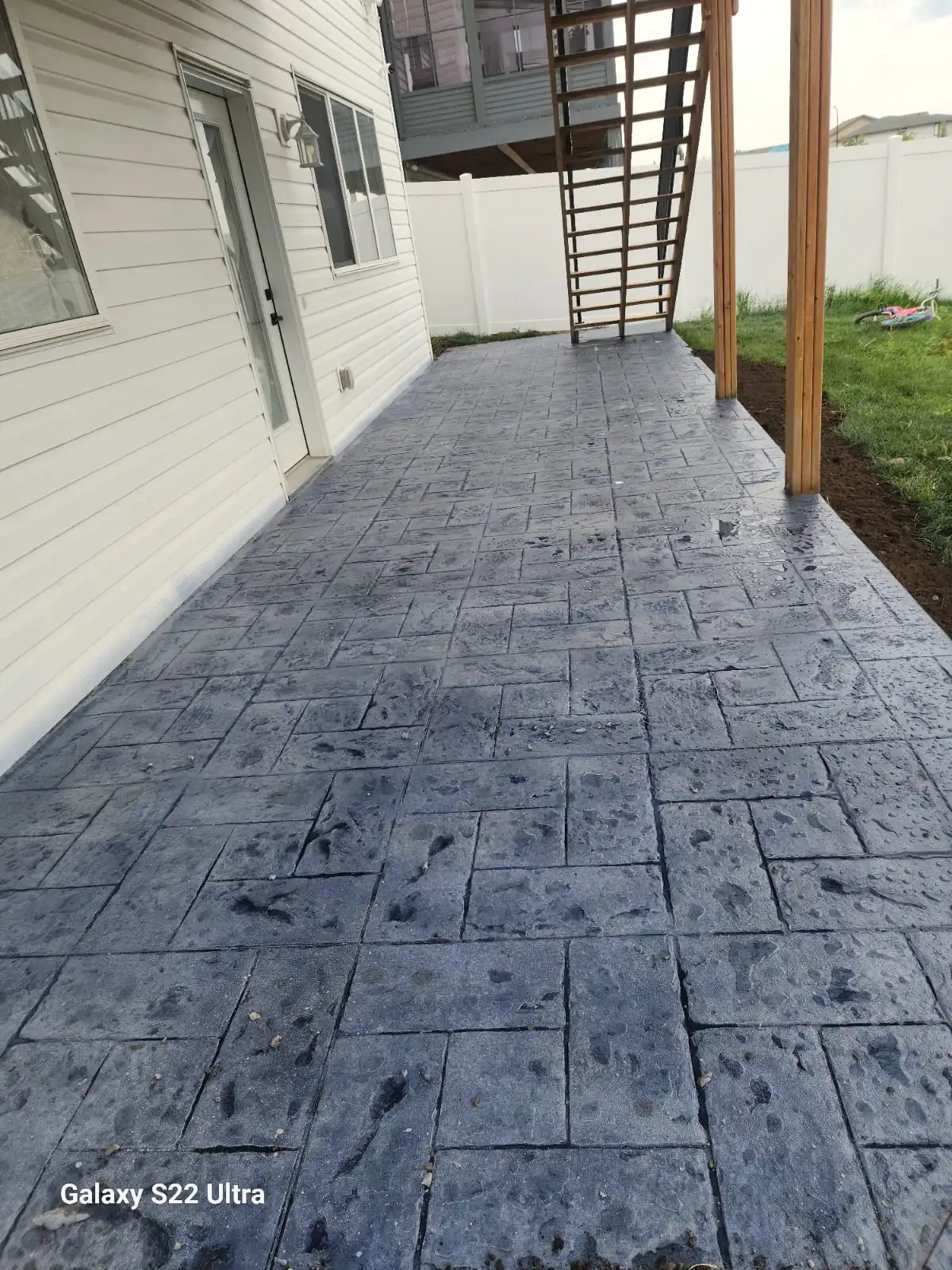
Plain concrete is porous but uniform. Stamped concrete has an additional surface layer — the colour hardener, release agent, and sealer applied during installation. That layer is what gives it the stone, brick, or wood appearance. It is also what makes it more vulnerable in Alberta winters:
- Sealer traps moisture: If water infiltrates a crack or pin hole in the sealer, it freezes, expands, and pushes the sealer off from underneath. You lose the protective layer and the colour with it.
- De-icing chemicals attack colour hardeners: Rock salt and calcium chloride dissolve the release agents used in stamped concrete, causing permanent colour fade and surface erosion within 1–2 seasons.
- Texture holds ice: The stamped pattern retains ice and snow better than a flat broom finish — meaning more surface contact time with de-icers. Note: if your stamped concrete was poured without air entrainment (5–7% air content), it is significantly more vulnerable to freeze-thaw spalling than properly specified concrete — meaning more surface contact time with de-icers if used incorrectly.
- Chinook cycles are the real threat: Rapid temperature swings from -25°C to +10°C in 24 hours cause the concrete to expand and contract faster than any sealer can flex with it. Unsealed or poorly sealed stamped concrete cracks along the stamped joints within 2–3 Alberta winters.
Pre-Winter Preparation: The September–October Window
The single most important thing you can do for a stamped concrete driveway in Red Deer is apply a penetrating sealer before freeze-thaw cycles begin. The window is September through mid-October — concrete needs to be above 10°C to cure the sealer properly, and the surface must be completely dry.
How to Inspect Before Sealing
- Look for hairline cracks along stamped joints — fill with a flexible polyurethane sealant before sealing
- Check for white haze or efflorescence (mineral deposits) — clean with a diluted muriatic acid wash before sealing
- Test existing sealer by dropping water on the surface — if it beads, the sealer is still working; if it absorbs, reseal now
- Check for spalling or flaking at edges — these need repair before winter, not after
Sealer Specification for Alberta Winters
- Use a solvent-based acrylic sealer (not water-based) for stamped concrete in Alberta — solvent-based sealers penetrate deeper and hold up better through freeze-thaw cycles
- Apply two thin coats rather than one thick coat — thick coats bubble and peel; thin coats bond properly
- Reapply every 2–3 years in Red Deer conditions — annual inspection, reseal when water stops beading
- Never seal in direct sun or wind — sealer dries too fast and leaves lap marks
Not sure if your sealer needs replacing? Gilbert Concrete offers free driveway inspections across Red Deer, Lacombe and Blackfalds. Book a free inspection or call (403) 391-9489.

Ready to get started? Gilbert Concrete offers free on-site estimates across Red Deer, Lacombe, Blackfalds and Central Alberta. Contact us online or call (403) 391-9489 — licensed, WCB insured, 2-year written warranty.
Snow Removal: Tools and Techniques That Protect Stamped Concrete
What to Use
- Plastic snow shovel only — never metal edge shovels on stamped concrete. Metal edges chip the sealer and dig into the textured surface on every pass.
- Snow blower with rubber paddle: Safe to use on stamped concrete. Keep the paddle adjusted so it does not contact the surface directly — leave a thin snow layer and clear the last inch by hand.
- Push broom for light snow: Under 5cm of dry snow, a stiff-bristle push broom clears the surface without any risk of damage.
What to Avoid
- Metal-tipped shovels or ice chippers — chips and scratches the sealer and stamped pattern permanently
- Aggressive scraping when snow is frozen to the surface — warm with hot water first, then remove
- Plows with steel blades making contact with the surface
De-Icing Products: What Is Safe and What Destroys Stamped Concrete
Never Use These on Stamped Concrete
- Rock salt (sodium chloride): Directly attacks colour hardeners and accelerates freeze-thaw spalling. Causes permanent staining and surface erosion. Most commonly used product — worst choice for stamped concrete.
- Calcium chloride: Works at lower temperatures but is highly corrosive to concrete sealers. Discolours stamped patterns within one season of use.
- Ammonium nitrate or ammonium sulfate: Found in some fertilizer-based de-icers. Chemically attacks concrete and causes rapid surface deterioration.
Safe Alternatives for Alberta Winters
- Fine sand or kitty litter: Provides traction without any chemical damage. Best first choice for stamped concrete. Sweep off in spring before it works into the texture.
- Potassium chloride (potash): Gentler on concrete sealers than rock salt. Works down to about -12°C — adequate for most Red Deer winter days but not chinook reversals.
- Calcium magnesium acetate (CMA): The safest chemical de-icer for concrete surfaces. More expensive but does not damage sealers or colour hardeners.
Common Winter Damage on Stamped Concrete and How to Respond
- Surface spalling: Freeze-thaw water infiltration popping the surface layer. Cause: failed sealer or de-icing chemicals. Response: stop using de-icers, reseal in spring, assess repair options with a concrete contractor.
- Hairline cracks along stamped joints: Normal expansion and contraction cracking. Response: fill with colour-matched flexible polyurethane caulk before winter makes them larger. A crack left unfilled through one Alberta winter typically doubles in width.
- Salt staining and white haze: Efflorescence or de-icer residue. Response: spring cleaning with a concrete-safe degreaser and light pressure wash. Do not high-pressure wash stamped concrete — it strips the sealer.
- Sealer peeling or bubbling: Moisture trapped under the sealer during application, or sealer applied too thick. Response: strip the old sealer in spring and reapply correctly in thin coats above 10°C.
Monthly Winter Maintenance Schedule for Red Deer
- September–October: Inspect surface and sealer, fill cracks with polyurethane sealant, reseal if water is absorbing rather than beading. Stock sand or potassium chloride for the season.
- November: First snowfall — clear with plastic shovel within 24 hours. Apply sand for traction at entrances. Check that downspouts drain away from the driveway surface.
- December–January: Peak freeze-thaw months. Clear snow promptly after each event. Never let meltwater pond on the surface and refreeze. Use sand only for traction — no rock salt.
- February–March: Chinook season — highest risk of rapid temperature damage. Watch for cracks forming along stamped joints after chinook events. Do not try to seal or repair in winter temperatures.
Noticed damage this winter? Do not try to repair stamped concrete below 10°C — repairs will not bond properly. Document the damage and call Gilbert Concrete in spring for a free assessment. (403) 391-9489.
Frequently Asked Questions — Stamped Concrete Winter Care Alberta
Concrete Services in Red Deer & Central Alberta
Gilbert Concrete handles all residential and commercial concrete work across Red Deer, Lacombe, Blackfalds and Sylvan Lake — stamped patio installation, driveway installation, foundation services, slab installation, concrete floor repair, and epoxy floor coating. Visit our homepage or check 2026 concrete pricing for Central Alberta.
More From the Gilbert Concrete Blog
How Much Does a Concrete Driveway Cost in Alberta? [2026 Guide]
Full pricing breakdown for concrete driveways across Red Deer and Central Alberta — materials, labour, and what drives cost up or down.
Read More →Winter Care Guide for Stamped Concrete Driveways in Red Deer
How to protect stamped concrete driveways through Alberta winters — sealing, snow removal, de-icing and what not to do.
Read More →How to Choose a Reliable Concrete Contractor in Red Deer
7 questions to ask before hiring — WCB, PSI specs, base prep depth, warranties and red flags that save you thousands.
Read More →Concrete Calculator Alberta 2026 — Slab, Driveway & Garage
Step-by-step formula to calculate cubic yards for any Alberta slab — with pre-calculated common sizes and PSI specs for Red Deer.
Read More →Free Stamped Concrete Inspection — Red Deer, Lacombe, Blackfalds
Gilbert Concrete offers free spring inspections for stamped concrete driveways across Red Deer and Central Alberta. We assess sealer condition, crack severity, and surface damage — and give you an honest written assessment of what needs doing. Licensed, WCB insured, 2-year written warranty on all repair and reseal work.