
How to Choose a Reliable Concrete Contractor for Your Patio in Red Deer
Hiring the wrong concrete contractor can cost Red Deer homeowners thousands in repairs within just a few years. This guide walks you through the exact questions to ask, red flags to avoid, and verification steps that protect your investment when choosing a reliable concrete contractor for your patio project.
The $12,000 Mistake That Changed How I Vet Contractors
Last spring, a homeowner in Normandeau called us three weeks after another contractor poured her backyard patio. The surface was already flaking. Water pooled against her foundation. The contractor stopped returning calls. She paid $8,500 for a disaster that would cost $12,000 to fix properly.
Here is what makes me angry about stories like this. Every single problem was preventable. The contractor skipped the proper base preparation. Used the wrong concrete mix for Alberta winters. Never pulled permits. Had no insurance. And she had no idea what questions to ask before signing the contract.
I have been installing concrete patios in Red Deer for over 15 years now. We have seen this pattern dozens of times. Homeowners get burned by contractors who talk a good game but cut corners the moment you hand over that deposit.
This guide gives you the exact checklist we wish every homeowner used before hiring any concrete contractor. Not just for hiring us, but for protecting yourself from the cowboys who give our industry a bad name.
What You Will Learn in This Guide
This is not another generic contractor checklist copied from some national website. Everything here comes from nearly two decades working in Red Deer’s unique climate and fixing mistakes other contractors made.
You will discover the seven specific questions that separate legitimate contractors from fly-by-night operators. The subtle red flags most homeowners miss during estimates. And the exact verification steps that take less than 30 minutes but could save you thousands.
We will cover current pricing ranges for Red Deer (as of December 2024), seasonal timing that matters in Central Alberta, and the technical specifications your contractor should know cold if they actually understand our climate.
By the end, you will know more about hiring concrete contractors than most people learn after getting burned once. And you will have a checklist you can use this weekend when you start getting estimates.
Fair warning though—some of what I am about to share contradicts the advice you will hear from contractors during their sales pitch. That is intentional.

Why Choosing the Right Contractor Actually Matters in Red Deer
Let me be direct about something the concrete industry does not like to admit. Most contractors who pour residential patios in Alberta learned their trade in warmer climates or never bothered learning the specific techniques our environment demands.
They treat Red Deer like it is Vancouver. Or Calgary. Or worse—they use the same methods that work fine in Texas or Arizona. The result? Patios that look great in July and fail by March.
Our Climate Is Brutal on Concrete
Central Alberta sits in this perfect storm of conditions that destroy improperly installed concrete. We swing from minus 30 Celsius in January to plus 30 in July. That 60-degree temperature variation alone would stress any material.
But the real killer is our freeze-thaw cycle count. Red Deer experiences 40 to 50 freeze-thaw cycles every year. Water seeps into concrete pores during the day when it is above freezing. Then it freezes at night and expands. This happens dozens of times between October and April. Concrete that is not specifically mixed and installed for these conditions will fail. Not might fail. Will fail.
I have watched contractors from Edmonton come down here and pour patios using standard mix designs. Within two winters, those surfaces are spalling—the technical term for when the top layer flakes off in chunks. Homeowners call us asking why their brand-new patio looks 20 years old. The contractor used a mix appropriate for gentler climates. It had no business being poured in Central Alberta.
The Cost of Getting It Wrong
Replacing a failed concrete patio is not like repainting a room. You cannot just fix it cheaply. A proper tearout and replacement for a medium-sized patio (300 square feet) runs $5,000 to $8,000 in Red Deer as of December 2024. That is on top of whatever you paid the original contractor.
But money is actually the smaller loss. The bigger problem is timing. Let’s say you hire a contractor in May. They pour your patio in June. By September, you notice some hairline cracks but figure that is normal. Winter hits. By April, those cracks are an inch wide and water is pooling. You call the contractor. Phone disconnected.
Now you have lost a full year. Your backyard is unusable for another summer while you find a legitimate contractor and get on their schedule. Your kids are another year older—missing out on outdoor memories you planned to create. And you are out $10,000 to $15,000 total when you factor in the original installation plus the replacement.
Property Value Impact
Real estate agents in Red Deer will tell you this. A quality patio can add $8,000 to $15,000 to your home’s value. It creates usable outdoor living space that buyers love.
But a cracked, settling, or poorly finished patio? That is a negotiation point working against you. Buyers see it as a problem they will need to fix. They either walk away or demand price reductions that exceed the repair cost.
I have seen homes sit on the market longer because of obviously failed concrete work in the backyard. Potential buyers assume—correctly—that if the visible concrete work is substandard, what else did the homeowner cheap out on?
The contractor you choose does not just affect your next few summers. It affects your home’s value and marketability for years.
Considering a new patio but not sure where to start? We offer free consultations where we walk your property and answer questions with no pressure.
What Questions Should I Ask Before Hiring a Patio Contractor?
This is where most homeowners blow it. They ask surface-level questions that any contractor—legitimate or not—knows how to answer convincingly.
“Do you have experience?” Yes.
“Are you insured?” Of course.
“Can you provide references?” Absolutely.
Those answers mean nothing without follow-up questions that actually verify the claims. Here are the seven questions that separate professionals from pretenders. These are uncomfortable to ask. Contractors who are not legitimate will squirm, make excuses, or ghost you after the conversation. That is your answer right there.
Can You Provide Your WCB Account Number Right Now?
Not “Are you insured with WCB?” That is too easy to answer yes to.
Ask for their actual WCB (Workers Compensation Board) account number on the spot. A legitimate contractor has this memorized or can pull it up on their phone in 30 seconds.
Then—and this is the critical part—you verify it yourself at WCB Alberta’s website. Their COR (Certificate of Recognition) lookup tool shows current coverage status. It takes three minutes.
Why this matters: WCB coverage protects you if a worker gets injured on your property. Without it, you are liable. I have seen homeowners sued for medical costs because they hired an uninsured contractor whose employee got hurt on site.
What legitimate contractors do: They hand you their WCB card right at the estimate appointment. They know you will verify it and have nothing to hide.
Red flag responses: “I will email that to you later.” Or “I am a sole proprietor so I do not need WCB.” (That is often true for solo operators, but then they should have alternative liability coverage they can prove.)
What Specific Concrete Mix Design Do You Use for Alberta Freeze-Thaw Cycles?
This technical question separates contractors who actually understand our climate from those who are winging it.
The correct answer involves air-entrained concrete with a specific air content percentage (usually 5% to 8% for exterior flatwork in Alberta). Those microscopic air bubbles give freezing water room to expand without cracking the concrete.
A knowledgeable contractor will also mention:
- Minimum 32 MPa (megapascals) compressive strength
- Maximum 0.45 water-cement ratio
- Aggregate size and type considerations
If their eyes glaze over when you ask this question, you are talking to someone who just calls a batch plant and orders “regular concrete.” That concrete will not survive here.
What I have heard from bad contractors: “We use the strongest concrete available.” (Vague and meaningless.)
“Four thousand PSI mix.” (That is American measurement and tells me nothing about air entrainment.)
“Whatever the concrete company recommends.” (Admitting they do not actually specify the mix.)
What legitimate contractors say: “We specify air-entrained concrete at 32 MPa with controlled air content between 6% and 8%. The batch plant provides us mix design documentation we can show you
How Deep Is Your Standard Base Preparation and What Materials Do You Use?
The base under your patio matters more than the concrete itself. A proper base prevents settling, allows drainage, and protects against frost heave.
For Red Deer specifically, you want to hear:
- Minimum 4 to 6 inches of compacted granular base (crush or road base material)
- Mechanical compaction in lifts (not just dumped and spread)
- Grading that directs water away from your foundation
- Consideration of soil conditions and existing drainage
Bad contractors will mention this stuff vaguely during their pitch. Good contractors can show you photos from previous jobs documenting their base prep process.
I once bid against a contractor in Timberlands who was $1,800 cheaper than us. The homeowner went with him. Six months later, a corner of the patio had settled three inches because the contractor did minimal base prep.
The homeowner paid us $2,400 to mud-jack the settled section and add proper drainage. He saved $1,800 upfront and spent $2,400 fixing the problem. Net loss of $600 plus the hassle and stress.
What to watch for: Contractors who gloss over base prep details or act like it is no big deal. That is where they cut costs and where your problems will start.
Do You Pull Permits and Can You Show Me Documentation?
This is controversial because small residential patios often do not require permits in Red Deer. But here is the thing—a contractor willing to skip permits when they are required will skip other important steps too.
Ask directly: “Does this project require a permit based on size and location? If yes, will you pull it? If no, can you explain why not?”
Legitimate contractors know local regulations. They can explain whether your specific project needs a permit based on:
- Distance from property lines
- Total square footage
- Impact on drainage or easements
For projects that do require permits, they handle the paperwork without making it your problem. They know the inspectors and have processes in place.
Red flag response: “Permits are a waste of money. Nobody bothers with those for patios.” (This tells you they cut corners habitually.)
Legitimate response: “Based on your property line distances and the patio size, we do not need a permit for this project. Here is the relevant bylaw section if you want to verify with the city.
What Is Your Process for Control Joints and Why?
Control joints are those deliberate lines or grooves cut into concrete. They give the concrete predetermined weak spots so when it inevitably cracks, the cracks happen along those lines invisibly rather than randomly across your surface.
Every concrete patio will develop some internal stress as it cures and experiences temperature changes. Control joints manage where that stress gets released.
A contractor who understands this will explain:
- Joint spacing based on slab thickness (typically every 8 to 10 feet)
- Joint depth (one-quarter to one-third of slab thickness)
- Timing (cut within 24 hours after pouring)
What bad contractors say: “We do not need control joints if we use good concrete.” (Wrong. All concrete needs them.)
“We will add them if you want but it costs extra.” (This should be standard, not an upsell.)
What good contractors say: “We cut control joints at 8-foot spacing within 12 hours after pouring. It is part of our standard process because it prevents random cracking.
Can You Provide Three Local References from Jobs Completed at Least Two Years Ago?
Notice the specificity here. Not just “references.” Three local references. From projects at least two years old.
Why two years? Because most concrete problems show up after the first or second winter. A reference from three months ago tells you nothing about durability.
Why local? Because you can drive by and actually see the work. You can verify the reference is real and not the contractor’s brother-in-law.
Call those references. Ask them:
- Did the contractor show up on schedule?
- How has the patio held up through winters?
- Were there any issues? If yes, how did the contractor handle them?
- Would you hire them again?
Red flag responses: “All our clients are private and do not want to be contacted.” (Nonsense. Happy clients are happy to provide references.)
“I can give you recent references but our older clients have moved.” (Convenient excuse.)
Legitimate response: The contractor hands you a printed sheet with names, phone numbers, addresses, and project dates. They are proud of their work and know it holds up.
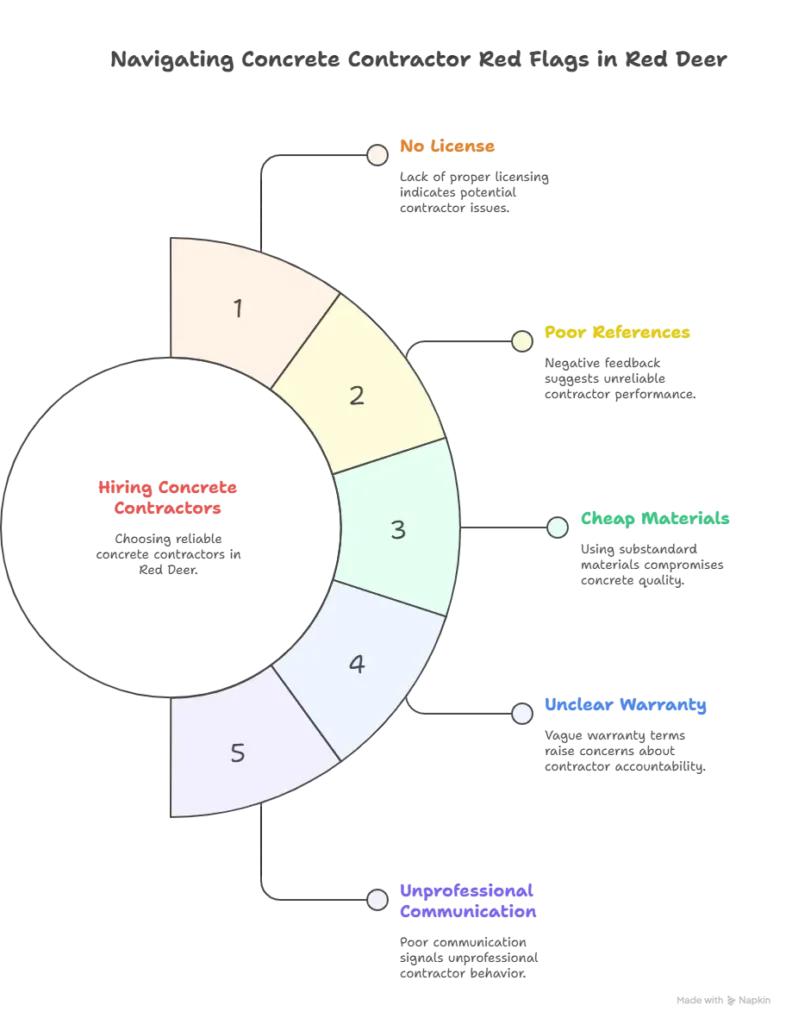
What Is Your Warranty and What Specifically Does It Cover?
Get this in writing before you sign anything. A verbal warranty is worthless when problems arise and the contractor claims they never promised that coverage.
A legitimate warranty should specify:
- Coverage period (typically 1 to 2 years for workmanship)
- What is covered (settling, cracking, surface defects)
- What is not covered (damage from impacts, chemicals, neglect)
- Process for making warranty claims
Be wary of contractors offering lifetime warranties. Concrete lasts decades, but contractors go out of business, retire, or move. A lifetime warranty from a fly-by-night operator is meaningless.
Better option: A shorter warranty (1 to 2 years) from an established contractor with a physical business address and track record.
What I have seen go wrong: A contractor offered a “5-year warranty” but when cracks appeared in year two, he argued the cracks were “normal settlement” and therefore not covered. The homeowner had no recourse because the warranty language was vague.
What Are the Red Flags That Should Make Me Walk Away?
I am about to share the warning signs that will save you thousands. Some of these seem obvious in hindsight, but they are incredibly common in Red Deer’s contractor market.
No Physical Business Address
If the contractor only provides a cell phone number and Gmail address with no physical business location, you are dealing with someone operating out of their truck.
This is not automatically disqualifying for sole proprietors just starting out. But combined with other red flags, it is a pattern.
Here is why it matters. When problems arise after the job, you need recourse. A contractor with an established business address has roots in the community. They care about local reputation. They are not going to disappear on you.
I have seen homeowners trying to track down contractors who vanished after the job. No office. No way to serve legal papers. No accountability.
What to do: Google the business address they provide. Does it match their website? Is it a residential address? A UPS store mailbox? Drive by if you are unsure.
Pressure for Large Upfront Payments
Standard payment structure for concrete work is:
- Small deposit (10% to 20%) to schedule and secure materials
- Bulk payment (60% to 70%) upon completion
- Final payment (10% to 20%) after walkthrough and approval
Any contractor demanding 50% or more upfront is either financially desperate or planning to take your money and run.
Last year, a contractor in Sylvan Lake took $8,000 deposits from four different homeowners, bought materials for two of the jobs, and vanished. He is now facing fraud charges, but those homeowners are still out their deposits.
What legitimate contractors say: “We require a $1,000 deposit to schedule your job and order materials. The remaining balance is due upon completion.”
Red flag response: “We need 60% upfront to buy materials and cover labor.” (Why do they not have business credit or cash flow to handle standard operating expenses?)
No Written Contract or Vague Terms
Every legitimate contractor provides a detailed written contract before work begins. This document should include:
- Exact scope of work (dimensions, finishes, materials)
- Total cost with payment schedule
- Project timeline with start and completion dates
- Materials specifications (concrete mix design, rebar gauge, etc.)
- Warranty terms
- Process for handling changes or additions
I have seen “contracts” that were one-paragraph emails. When problems arose, the homeowner and contractor had completely different memories of what was agreed upon. The homeowner lost in small claims court because there was no documentation.
What to insist on: A multi-page contract that specifies everything. If the contractor acts like this is unreasonable, walk away.
Quotes That Are 30% or More Below Competition
You get three quotes for your 300-square-foot patio:
- Contractor A: $5,400
- Contractor B: $5,800
- Contractor C: $3,200
Your instinct says Contractor C is offering a great deal. Your experience should say Contractor C is cutting corners.
Here is the reality of concrete pricing in Red Deer as of December 2024. Materials cost what they cost. Concrete, rebar, and gravel have relatively fixed prices. Labor for qualified crews runs $60 to $85 per hour.
A contractor bidding 30% to 40% below market is either:
- Using inferior materials
- Skipping critical steps (base prep, proper curing)
- Employing unqualified labor
- Planning to upsell you later with “unexpected” costs
- Not properly licensed or insured (saving on overhead)
All of those scenarios end badly for you.
What I tell homeowners: If one quote is dramatically lower, ask specifically where they are saving money. “Your quote is $2,000 less than others. Can you explain what you are doing differently?” Their answer will tell you everything.
Unwillingness to Provide Insurance Certificates
A legitimate contractor should be able to provide proof of:
- WCB coverage (workers compensation)
- General liability insurance ($2 million minimum coverage is standard)
They should be able to email you these certificates within a day. If they stall, make excuses, or act offended that you asked, that is your answer.
Why this matters: If an uninsured worker gets hurt on your property, your homeowner’s insurance becomes the target. I have watched homeowners deal with lawsuits because they hired an uninsured contractor whose employee fell off scaffolding.
What to do: Ask for insurance certificates before signing anything. Call the insurance provider to verify the policy is current. This takes 15 minutes and could save you $100,000 in liability.
Feeling overwhelmed by the contractor search process? We have helped dozens of Red Deer homeowners navigate these decisions. Schedule a free consultation and we will answer your questions honestly—even if you do not hire us.

How Do I Verify a Contractor’s Credentials in Alberta?
Asking questions is step one. Verifying the answers is step two. Most homeowners skip the verification because they assume contractors would not lie. That assumption costs people thousands every year. Here is your verification checklist. Print this out and work through it before you sign a contract.
Where Can I Check WCB Coverage Online?
Go to WCB Alberta’s website (wcb.ab.ca) and use their COR Registry lookup tool. You need the contractor’s legal business name or WCB account number.
The registry will show:
- Current coverage status
- Coverage dates
- Account number verification
This takes less than five minutes. If their coverage is lapsed or inactive, you are dealing with someone operating illegally. Do not hire them regardless of how good their price is .
How Do I Confirm General Liability Insurance Is Current?
The contractor should provide you with a Certificate of Insurance from their insurance broker. This certificate lists:
- Policy number
- Coverage amounts
- Effective dates
- Insurance company contact information
Call that insurance company directly (use the number from their website, not the one on the certificate). Ask them to confirm:
- Is this policy currently active?
- What is the coverage amount?
- Does it cover residential concrete work?
Insurance fraud is rare but happens. Contractors photoshop expired certificates or provide documentation for policies they let lapse. Verify directly with the insurer.
What Can I Learn from BBB and Google Reviews?
Check the Better Business Bureau Alberta website and Google Reviews. But read reviews intelligently.
Every contractor will have some negative reviews. Construction is complicated and sometimes legitimate disputes happen. What you are looking for is patterns:
- Multiple complaints about the same issue (disappearing after payment, poor quality, no warranty follow-through)
- How the contractor responds to negative reviews (professional and solutions-oriented versus defensive and blaming)
- Ratio of positive to negative (95% positive with occasional complaints is normal)
Red flags in reviews:
- Contractor does not respond to any reviews (shows they do not care about reputation)
- All reviews are 5-star with generic praise (likely fake reviews)
- Multiple mentions of the same red flags we discussed (demanding large upfront payments, poor communication, substandard work)
What legitimate contractors show:
- Mostly positive reviews with specific details
- Professional responses to complaints explaining what happened and how they resolved it
- Recent reviews (shows active business)
Can I Verify Business Registration and Licensing?
Check the Alberta Corporate Registry to verify the business actually exists and is in good standing. You are looking for:
- Registered business name matching what is on their website and truck
- Registration date (how long they have been operating)
- Status (active or dissolved)
For businesses operating in Red Deer specifically, you can also check city business licensing records.
This verification tells you if you are dealing with an established business or someone operating under a made-up name.

What Should I Know About Concrete Patio Pricing in Red Deer?
Let’s talk numbers. Understanding typical pricing helps you spot quotes that are either overpriced or suspiciously cheap.
As of December 2024, here are the ranges I am seeing in Red Deer for quality work:
Basic broom finish concrete:
- $12 to $16 per square foot installed
- This includes proper base prep, 4-inch concrete thickness, basic finishing
- Example: 300 sq ft patio = $3,600 to $4,800
Stamped or decorative concrete:
- $16 to $22 per square foot installed
- Includes pattern stamping, integral color, sealer
- Example: 300 sq ft patio = $4,800 to $6,600
Exposed aggregate finish:
- $15 to $20 per square foot installed
- Includes aggregate exposure, sealing, edging
- Example: 300 sq ft patio = $4,500 to $6,000
These prices assume reasonable site access, level ground, and standard soil conditions. Prices increase if:
- Site requires significant excavation or grading
- Access is difficult (narrow side yards, no alley access)
- Removal of existing patio or deck is needed
- Complex shapes or multiple levels
- Premium color or pattern selections
Why Does Pricing Vary So Much Between Contractors?
You will get quotes ranging from $8 per square foot to $25 per square foot for what seems like the same work. Here is why:
Lower-priced contractors may be:
- Operating without proper insurance (lower overhead)
- Using cheaper materials (standard concrete mix instead of air-entrained)
- Cutting base prep time and materials
- Employing less experienced crews
- Skipping steps like proper curing or sealing
Higher-priced contractors may offer:
- Longer warranties and better customer service
- More experienced crews with specialized skills
- Higher-grade materials and finishes
- More thorough base preparation
- Better communication and project management
Not all expensive contractors provide better value. But all suspiciously cheap contractors cut corners somewhere.
What Should I Compare When Looking at Multiple Quotes?
When you have three quotes in hand, create a comparison chart. List:
- Total price per square foot
- Concrete specifications (MPa, air entrainment, thickness)
- Base preparation depth and materials
- Included finishes and sealers
- Warranty terms and length
- Project timeline
- Payment schedule
The lowest quote often looks worse when you compare what is actually included. A $3,200 quote using standard concrete with 3 inches of gravel base is not comparable to a $5,400 quote using air-entrained concrete with 6 inches of properly compacted road base.
You are not comparing apples to apples. You are comparing fruit to vegetables.
Want to know what a quality patio should cost for your specific property? We provide detailed, itemized estimates with no obligation. Request your free quote and see exactly what you are paying for
When Is the Best Time to Hire a Concrete Contractor in Alberta?
Timing matters more than most homeowners realize. Concrete work is weather-dependent, and Red Deer’s climate creates narrow windows for optimal results.
What Are the Ideal Months for Pouring Concrete?
The sweet spot for concrete work in Central Alberta runs from late May through early September. Here is why:
Concrete needs consistent temperatures above 5 degrees Celsius to cure properly. Curing is the chemical process where concrete hardens and gains strength. Cold temperatures slow this process or stop it entirely.
Pour concrete when overnight temps dip below freezing and you risk:
- Incomplete curing (concrete never reaches full strength)
- Surface scaling and spalling
- Internal cracking from ice formation
Best months: June, July, August
Acceptable with precautions: May, September
Avoid unless using special measures: October through April
That said, experienced contractors can extend the season using insulated blankets, ground heaters, and hot water mixes. But this adds cost and complexity.
If you are planning a patio for next summer, start contractor research and getting quotes in February or March. Good contractors book up 6 to 8 weeks out during peak season.
Does Weather Affect My Project Timeline?
Absolutely. Even during ideal months, weather can disrupt schedules. A rain shower the day before pouring means rescheduling—you cannot pour concrete on saturated ground or into standing water. A heat wave during curing requires extra attention to prevent rapid water evaporation.
Legitimate contractors will be honest about weather impacts. They will not pressure you to pour during marginal conditions just to hit their schedule. I have rescheduled jobs three times waiting for proper conditions. It frustrates everyone, but pouring in bad conditions costs more in the long run when the patio fails.
Frequently Asked Questions About Hiring Concrete Contractors
Ready to Start Your Patio Project With Confidence?
You now know more about hiring concrete contractors than 95% of Red Deer homeowners. You have the questions that separate professionals from pretenders. You understand the red flags that signal trouble. And you know exactly how to verify credentials before signing anything.
Most importantly, you understand why proper installation matters so much in our Alberta climate. A patio poured correctly will serve your family for decades. A patio done poorly becomes an expensive problem within a few winters.
The contractor you choose affects more than just your backyard. It affects your summer memories, your property value, and whether you spend next spring enjoying your outdoor space or dealing with repairs.
Take this checklist with you when you meet contractors. Ask the uncomfortable questions. Verify the answers. Do not let a smooth sales pitch override your due diligence.
Your family deserves an outdoor space that works. Your bank account deserves protection from costly mistakes. And your home deserves a patio built by someone who understands what Central Alberta’s climate demands.
If you want to discuss your patio project—whether you are ready to move forward or just exploring options—we will give you straight answers with no pressure. We have been doing this work in Red Deer for 17 years. We will tell you what makes sense for your property, your budget, and your timeline. Learn more about our concrete patio installation services and how we ensure quality results.
What is your biggest concern about hiring a concrete contractor? Share in the comments below and I will answer based on our experience working in Red Deer.