How Much Does a Concrete Driveway Cost in Alberta? [2025 Guide]
Last Tuesday, a homeowner from Bower called me in a panic. He’d just received three wildly different quotes for his driveway—$8,500, $14,200, and $22,000—for the same 600 square foot project. “How is this even possible?” he asked, frustrated and confused.
Here’s what nobody tells you: concrete driveway costs in Alberta aren’t just about square footage. They’re about timing, soil conditions, your contractor’s overhead, material quality, and whether you’re in Red Deer or a rural area 40 minutes outside the city. After fifteen years working with Gilbert Concrete and installing over 450 driveways across Central Alberta, I’ve seen homeowners overpay by $6,000 because they didn’t understand what drives pricing—and I’ve seen others get burned by suspiciously low bids that led to cracked, failing driveways within 18 months.
The average concrete driveway in Alberta costs between $12 and $22 per square foot installed in 2025, but that range is almost useless without context. A basic 400 square foot driveway in Red Deer typically runs $5,600 to $8,800, while that same project in Calgary might cost $6,400 to $10,200 due to higher labor rates and material transportation costs. Add decorative finishes, extensive excavation, or installation during peak season, and you’re easily looking at $25 to $35 per square foot.
In this guide, you’ll discover the real factors that determine concrete driveway costs across Alberta—not the generic national averages you’ll find everywhere else. I’ll break down the actual 2025 pricing from Red Deer, Calgary, Edmonton, and smaller communities. You’ll learn when to avoid the cheapest bid (and when it’s actually the smartest choice), how Alberta’s freeze-thaw cycles affect your installation timeline and costs, and the three questions that separate qualified contractors from the ones who’ll disappear when your driveway starts settling. I’m also sharing the exact cost breakdowns from five recent projects, including one where we saved a homeowner $4,200 by scheduling strategically and one where spending an extra $2,800 upfront prevented a $12,000 repair three years later.
Whether you’re replacing a crumbling asphalt driveway in Sylvan Lake, installing your first concrete driveway in a new build in Penhold, or trying to figure out if that quote from your neighbor’s “concrete guy” is legitimate, you’ll finish this guide knowing exactly what you should pay and why.
What Actually Determines Concrete Driveway Costs in Alberta?
Most cost calculators give you a price per square foot and call it a day. That’s like estimating your grocery bill based only on the number of items in your cart—it completely ignores what you’re actually buying.
Here’s what really drives the price of your concrete driveway in Alberta, starting with the factors contractors actually use when they calculate your quote.
Base Material Costs and Quality Grades
Not all concrete is created equal, and in Alberta’s brutal climate, this matters more than anywhere else in Canada.
Standard residential concrete (3000 PSI) costs approximately $140 to $165 per cubic yard delivered in Red Deer as of December 2024. That same concrete runs $155 to $180 per cubic yard in Calgary due to higher aggregate costs and increased demand. For a typical 400 square foot driveway at 4 inches thick, you’re looking at roughly 4.9 cubic yards, putting your base material cost between $686 and $882 before any delivery fees or quality upgrades.
But here’s where it gets interesting: I recommend 3500-4000 PSI concrete with air entrainment for every driveway I install in Central Alberta. Why? Because our concrete driveways need to survive 40+ freeze-thaw cycles every winter. According to the Cement Association of Canada, air-entrained concrete can handle up to 300 freeze-thaw cycles compared to just 25-50 cycles for standard concrete. That upgrade costs an additional $15 to $25 per cubic yard, adding roughly $75 to $125 to your total project cost—but it can extend your driveway’s lifespan from 15-20 years to 30-40 years.
I learned this lesson the hard way in 2018. A client in Blackfalds insisted on standard 3000 PSI concrete to save $180 on his $9,200 project. Eighteen months later, we were back doing concrete driveway repair after surface scaling damaged nearly 30% of the surface. The repair cost him $2,400—thirteen times what he “saved.”
Fiber-reinforced concrete is another upgrade worth considering. Adding synthetic fibers costs about $8 to $12 per cubic yard and dramatically reduces surface cracking during the curing process. For driveways in areas with heavy clay soil (common throughout Red Deer County and Lacombe County), this is cheap insurance against shrinkage cracks.
Excavation and Site Preparation Complexity
This is where quotes start diverging wildly—and where homeowners get the biggest surprises.
Basic excavation for a driveway with a good existing base costs around $2.50 to $4.50 per square foot in Red Deer. For a 400 square foot driveway, that’s $1,000 to $1,800. But if you’re replacing an existing concrete or asphalt driveway, removal and disposal add another $3.50 to $6.00 per square foot. Suddenly, you’re looking at $2,400 to $4,200 just for excavation and removal.
Soil conditions make an even bigger difference. Last summer, we quoted a straightforward driveway replacement in Innisfail at $11,200. When we started excavation, we discovered the entire driveway was built over poorly compacted fill soil with no proper base. We had to excavate an additional 8 inches, import and compact 12 cubic yards of Class II gravel base, and install proper drainage. The final cost: $16,800. The homeowner was frustrated, but here’s the reality—if we’d poured over that unstable base, his driveway would have cracked and settled within two years.
Alberta’s clay-heavy soils require 6 to 8 inches of compacted granular base in most areas. In Red Deer, Sylvan Lake, and surrounding communities, you’re dealing with expansive clay that swells when wet and shrinks when dry. Skimping on base preparation is the number one cause of premature driveway failure, I see. According to the Alberta Transportation guidelines for pavement design, proper base preparation can prevent up to 80% of settlement-related failures.
Slope and drainage add another layer of complexity. Your driveway needs a minimum 2% slope (2 inches of fall per 10 feet) to prevent water pooling. If your lot doesn’t naturally provide this, your contractor needs to create it through careful grading. I’ve seen contractors skip this step to save time, and I’ve seen the homeowners deal with sheet ice every winter because water pools and freezes. Proper drainage work adds $800 to $2,200, depending on your lot’s existing grade
Labor Rates and Contractor Overhead
Labor is typically 40-50% of your total driveway cost in Alberta, and rates vary significantly by location and contractor type.
In Red Deer, experienced concrete crews charge between $65 and $95 per hour per worker for driveway installation. A typical 400 square foot driveway requires a 3-4 person crew working 6-8 hours for excavation, forming, pouring, and finishing. That’s roughly 24-32 labor hours at $65-95 per hour, putting your labor cost between $1,560 and $3,040.
Calgary’s labor rates run 15-25% higher—$75 to $120 per hour—due to the higher cost of living and greater demand for skilled concrete finishers. Edmonton falls somewhere in between at $70 to $105 per hour. In smaller communities like Ponoka, Eckville, or Rimbey, you might find crews willing to work for $55 to $75 per hour, but you need to verify their experience with residential driveways specifically.
Here’s what I wish homeowners understood: the cheapest labor often costs you the most in the long run. Last year, a homeowner in Deer Meadows hired a crew charging $45 per hour—barely half the going rate. They finished his driveway in one day instead of the typical two-day process. Six months later, the surface was spalling, edges were crumbling, and we discovered they’d used improper concrete mix ratios and hadn’t properly vibrated the concrete during placement. The complete replacement cost $13,800. He “saved” $2,100 in labor and lost $13,800.
Established contractors with proper insurance, workers’ compensation coverage, and business overhead have higher rates for good reason. My insurance alone costs $8,400 annually. Workers’ compensation adds another 12-15% to labor costs. Vehicle maintenance, equipment, licensing, and administrative overhead add up quickly. When you see a quote that seems too good to be true, you’re usually looking at either an uninsured contractor, someone cutting corners on materials or process, or someone who’ll disappear when problems emerge.
Decorative Finishes and Customization
Standard broom-finished concrete is the baseline. Everything beyond that adds cost—but also significantly impacts your home’s curb appeal and resale value.
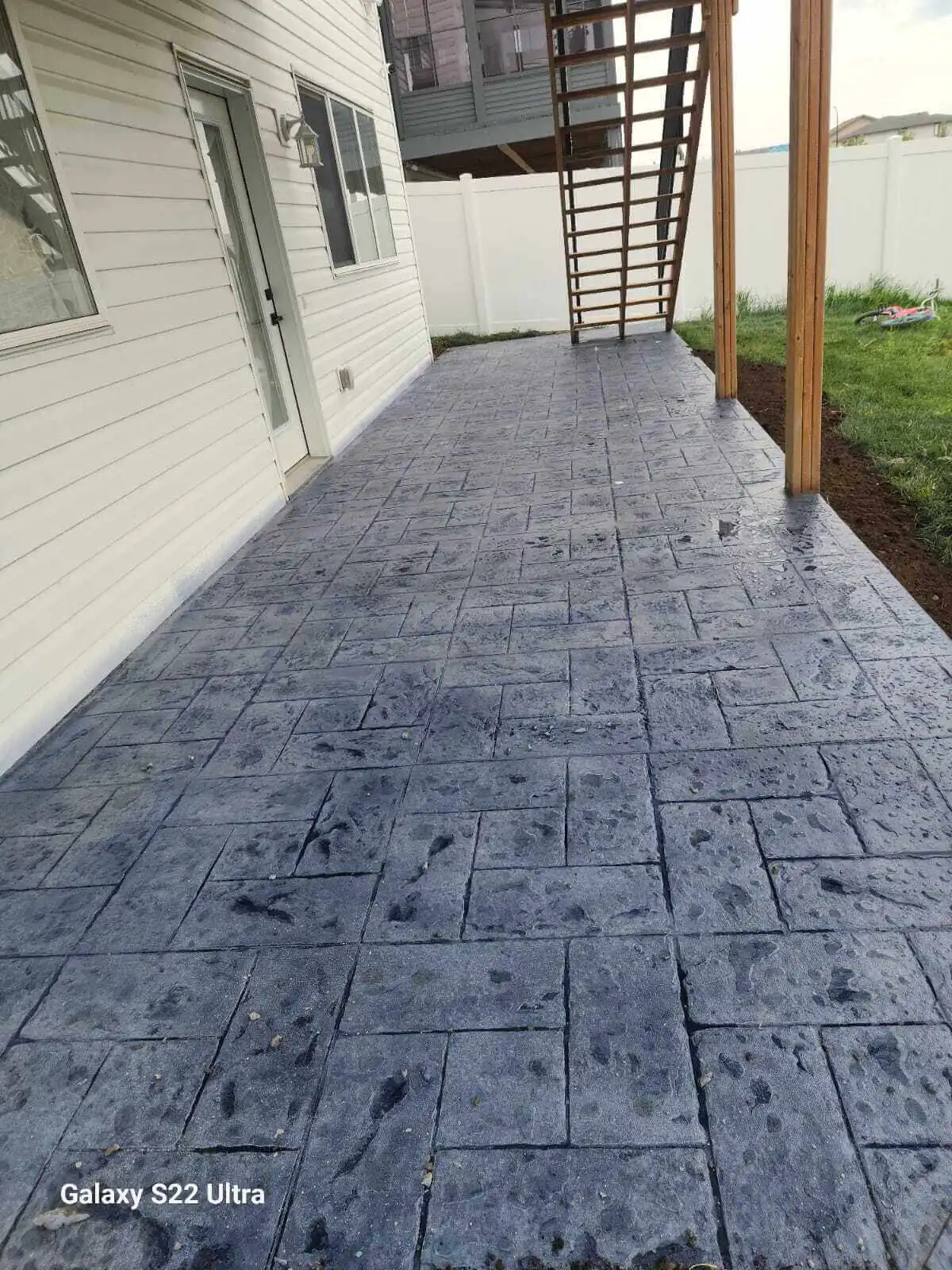
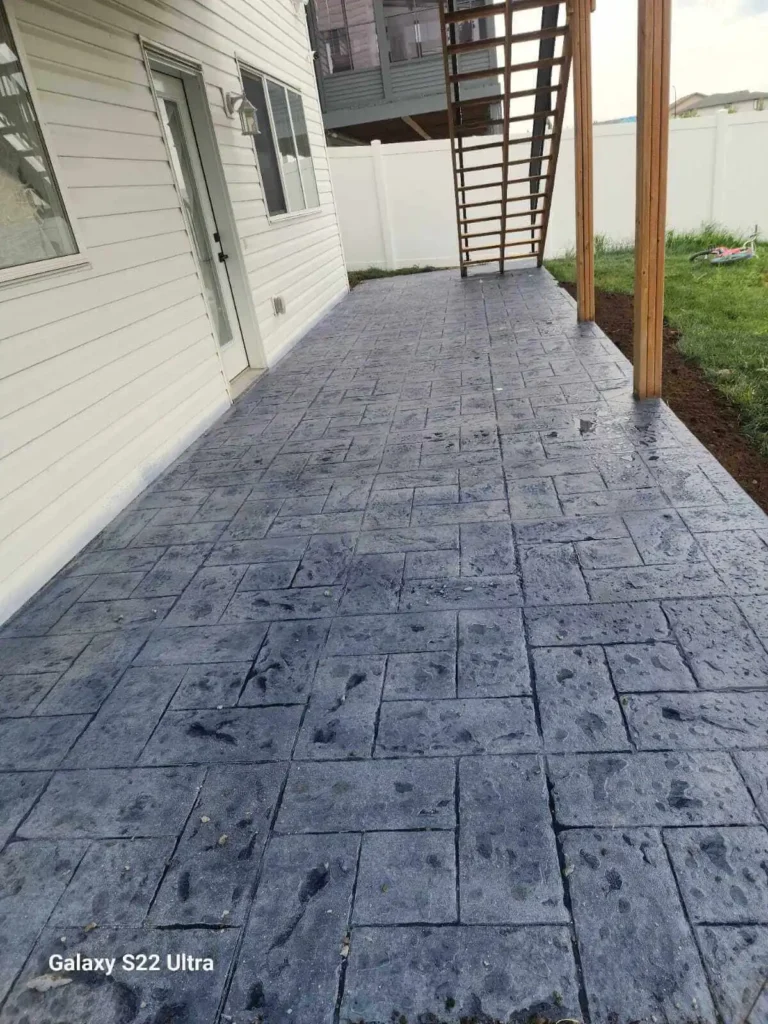
Stamped concrete is the most popular decorative option I install. Stamping adds $8 to $15 per square foot to your base cost, putting a 400 square foot stamped driveway at $8,800 to $14,800 total. The wide price range reflects pattern complexity—a simple ashlar slate pattern runs cheaper than intricate cobblestone or wood plank patterns that require multiple stamp mats and detailed hand-tooling.
I’ve installed over 80 stamped concrete driveways in the past five years, and the ROI is real. According to the National Association of Realtors, decorative concrete can return 70-80% of its cost in added home value, compared to just 40-50% for standard concrete. A well-executed stamped driveway in Red Deer’s popular neighborhoods—Timberlands, Vanier Woods, Kentwood—can add $4,000 to $8,000 to your home’s perceived value.
Exposed aggregate is my second most requested finish. This involves washing the surface to expose the decorative aggregate underneath, creating a textured, non-slip surface that’s perfect for Alberta winters. The process adds $4 to $8 per square foot. For a 400 square foot driveway, that’s an additional $1,600 to $3,200. I particularly recommend exposed aggregate driveways for homes in areas with mature trees, where leaves create slippery conditions in the fall.
Colored concrete uses integral color or dry-shake hardener to tint the concrete. Integral color adds $1.50 to $3.50 per square foot and provides color throughout the entire slab—critical if you chip or crack and expose fresh concrete. Dry-shake color is cheaper at $0.75 to $1.50 per square foot but only colors the surface. After installing both for over a decade, I only use integral color now. Surface coloring fades unevenly and looks patchy after 5-7 years.
Borders and accent bands create visual interest and can tie your driveway into existing hardscaping. A contrasting color border adds $12 to $18 per linear foot. For a typical driveway with 80 linear feet of borders, that’s $960 to $1,440. It sounds expensive until you see how dramatically it transforms a basic driveway into a cohesive landscape feature.
Seasonal Timing and Weather Constraints
Alberta’s weather creates a clear hierarchy of installation costs based on timing, and understanding this can save you thousands.
Peak season (May to September) brings premium pricing. Contractors are booked 4-8 weeks out, have multiple crews running simultaneously, and can be selective about projects. Summer 2024, I was charging full price—$16 per square foot for standard driveways—and turning down 30% of inquiries because we were at capacity. Supply and demand economics are brutal in peak season.
Shoulder season (April and October) offers the sweet spot. The weather is cooperative enough for quality installation, but demand drops 40-50%. I typically offer 10-15% discounts in these months to keep crews working. That same 400 square foot driveway that costs $6,400 in July might cost $5,440 to $5,760 in early October. The concrete cures more slowly in cooler temperatures—actually beneficial for achieving maximum strength—and contractors appreciate steady work as the season winds down.
Winter installation (November to March) is possible but expensive and risky. We can pour concrete in temperatures as low as 5°C using heated enclosures, insulated blankets, and accelerating admixtures. But it adds 25-40% to costs due to additional materials, labor, and risk. A $6,400 summer driveway might cost $8,000 to $8,960 in January. I only recommend winter pours for urgent situations—like a garage addition that needs access before spring.
Temperature also affects curing. Concrete gains strength through hydration, a chemical reaction that slows dramatically below 10°C. According to Portland Cement Association research, concrete cured at 5°C takes twice as long to achieve the same strength as concrete cured at 20°C. We use calcium chloride accelerators in cool weather, but they cost $15 to $25 per cubic yard and can potentially cause corrosion if you use metal reinforcement improperly.
I’ve had homeowners argue for winter installation to “get it done,” and I’ve had to walk away from projects. In December 2022, a Springbrook homeowner insisted on immediate installation despite -8°C forecasts. I declined. He found a contractor who’d do it. By March, the driveway had 14 major cracks. The contractor was unreachable. The homeowner spent $11,200 on removal and replacement that spring—double what patience would have cost him.
Permits, Inspections, and Regulatory Requirements
Red Deer and most Alberta municipalities require permits for driveway installation or replacement, and permit costs vary by location.
Red Deer charges $168 for a residential driveway permit as of 2025. The permit ensures your driveway meets setback requirements (typically 0.6 meters from property lines), doesn’t exceed maximum width (usually 50% of lot frontage or 7 meters, whichever is less), and maintains proper drainage slopes. Application processing takes 5-10 business days.
Calgary’s permit fees run slightly higher at $195, with stricter requirements for stormwater management in new developments. Edmonton charges $172 for standard residential driveways. Smaller communities like Sylvan Lake ($85), Penhold ($75), and Lacombe ($95) have lower permit costs but similar requirements.
Here’s where contractors differ: experienced, legitimate contractors factor permits into every quote and handle the application process. We include permit costs in our base price and manage the entire approval process. Fly-by-night contractors often skip permits entirely, saving you $150-200 upfront and potentially costing you thousands when you try to sell your home and discover the unpermitted work.
I’ve seen homeowners face forced removal of unpermitted driveways during home sales. The worst case: a Westlawn homeowner who discovered during his sale that his contractor had installed the driveway 0.3 meters onto a city easement. The city required complete removal. He lost his $14,200 driveway investment, plus paid $3,800 for removal, all because his “affordable” contractor skipped the $168 permit.
Some municipalities also require a compliance inspection after installation. Red Deer doesn’t routinely inspect residential driveways, but they can request an inspection if there’s a drainage complaint from neighbors. Calgary requires inspection for driveways in new subdivisions. Factor in an additional half-day of contractor time if inspection is required—usually built into the quote, but worth confirming.
Real 2025 Concrete Driveway Costs Across Alberta
Generic cost estimates are useless without real project context. Here’s what actual homeowners paid for concrete driveways across Alberta in 2024-2025, with the specific factors that influenced each price.
Red Deer and Central Alberta Pricing
Project 1: Basic Replacement in Riverside Meadows
- Size: 380 square feet (single car, 10′ × 38′)
- Scope: Remove existing cracked concrete, install 4″ new concrete with broom finish
- Soil conditions: Good existing gravel base, minimal prep needed
- Timeline: Late May 2024 (peak season)
- Total cost: $6,270 ($16.50/sq ft)
This represented straightforward, no-surprises pricing for a standard replacement. The existing driveway had a proper base; we only needed 4 inches of excavation, and the homeowner chose standard 3500 PSI air-entrained concrete with a basic broom finish. At $16.50 per square foot, this was median pricing for peak season work in Red Deer.
Project 2: New Construction in Timberlands
- Size: 580 square feet (double car, 20′ × 29′)
- Scope: New installation, stamped concrete in ashlar slate pattern, earth tone color
- Soil conditions: New construction, required 8″ gravel base installation
- Timeline: September 2024 (shoulder season)
- Total cost: $13,340 ($23/sq ft)
The homeowner saved roughly $1,800 by waiting until September instead of installing in July. Stamped concrete added $8 per square foot, integral color added $2.50 per square foot, and the extensive base preparation (required for new construction) added $3 per square foot over standard replacement costs. This project showed the premium for decorative finishes but also the savings available through strategic timing.
Project 3: Rural Property Near Penhold
- Size: 720 square feet (oversized double car, 24′ × 30′)
- Scope: Replace failing asphalt with concrete, exposed aggregate finish
- Soil conditions: Heavy clay requiring soil stabilization and enhanced drainage
- Timeline: October 2024 (late shoulder season)
- Total cost: $15,480 ($21.50/sq ft)
This project illustrated how soil conditions drive costs. We had to remove 14 inches of existing asphalt and unstable base, install geotextile fabric to prevent clay contamination, bring in 16 cubic yards of Class II base, and install french drain along one edge for water management. The exposed aggregate finish added $5 per square foot. Despite the complexity, October timing kept labor costs reasonable—this same project would have cost $17,650 in July.
Project 4: Upgrade in Vanier Woods
- Size: 450 square feet (standard double car, 18′ × 25′)
- Scope: Full decorative upgrade—stamped concrete, border, integrated steps
- Soil conditions: Existing concrete in good condition, minimal excavation
- Timeline: June 2024 (peak season)
- Total cost: $12,150 ($27/sq ft)
This was pure curb appeal investment. The homeowner wanted architectural stamped pattern matching their front walkway, a 6-inch contrasting border, and three integrated steps from the driveway to the front entrance. The decorative elements added $11 per square foot over basic stamped concrete. The client listed their home four months later, and their realtor attributed $8,500 of their over-asking sale to the exceptional front yard presentation. ROI: roughly 70% in four months.
Project 5: Budget-Conscious Installation in Bower
- Size: 360 square feet (single car, 12′ × 30′)
- Scope: Basic concrete replacement, standard finish, minimal customization
- Soil conditions: Acceptable existing base with minor amendments needed
- Timeline: April 2024 (early shoulder season)
- Total cost: $4,680 ($13/sq ft)
This demonstrated the lowest responsible price point in Red Deer. We installed in early April when the weather was cooperative, but demand was low. The homeowner chose 3500 PSI concrete (proper quality), standard broom finish (no decorative elements), and we worked with existing drainage slopes. At $13 per square foot, this was roughly 20% below peak season pricing for equivalent work. The homeowner understood we’d reschedule if the weather turned, which built flexibility into our schedule and kept costs down.
Calgary Metropolitan Area Costs
Calgary’s higher labor rates and material costs push driveway prices 15-25% above Red Deer averages.
A standard 400 square foot driveway with broom finish costs $7,200 to $9,600 in Calgary (versus $5,600 to $8,000 in Red Deer). The premium reflects higher wages—Calgary concrete finishers earn $75-120 per hour compared to $65-95 in Red Deer—and increased material delivery costs for projects outside the city’s ready-mix concrete plant service areas.
According to my contacts at Calgary-based concrete companies, stamped concrete driveways in desirable neighborhoods like Aspen Woods, Mahogany, or Evanston run $24 to $32 per square foot for quality installation. That’s 20-25% above comparable Red Deer pricing. The premium reflects market demand—Calgary homeowners have higher average incomes and a greater willingness to invest in curb appeal improvements.
Calgary also has stricter stormwater management requirements in newer communities. Many subdivisions built after 2018 require pervious concrete borders or integrated drainage systems, adding $1,200 to $2,800 to standard driveway costs. Red Deer has adopted similar requirements in some new developments, but enforcement is less consistent.
Edmonton Area Pricing
Edmonton pricing falls between Red Deer and Calgary, typically 10-15% above Central Alberta rates.
A 400 square foot basic concrete driveway in Edmonton costs $6,400 to $8,800—slightly higher than Red Deer but below Calgary. Decorative options like stamped concrete run $21 to $28 per square foot, depending on neighborhood and contractor workload.
Edmonton’s clay soil conditions are particularly challenging. The city sits in a bowl with heavy clay throughout most residential areas. Proper base preparation is non-negotiable, and contractors who skip it face callbacks. I’ve worked with Edmonton contractors on knowledge sharing, and they consistently report that base preparation costs run 15-20% higher than Red Deer due to clay excavation difficulty and the need for deeper, more robust gravel bases.
One advantage: Edmonton has more concrete contractors competing for work, which creates modest price competition that can benefit homeowners willing to get 4-5 quotes. Just ensure you’re comparing equivalent quality specifications—lowest bid often means lowest quality or hidden surprises.
Small Town and Rural Area Variations
Smaller Alberta communities present interesting pricing dynamics.
Sylvan Lake, Lacombe, and Blackfalds (within 20-30 minutes of Red Deer) typically match Red Deer pricing within $1-2 per square foot. These communities have sufficient local contractor availability, and material delivery is straightforward.
More remote areas like Eckville, Rocky Mountain House, or Sundre see 10-20% price increases primarily due to material delivery fees and contractor travel time. A concrete plant in Red Deer charges a $35-50 delivery fee for local pours but $120-180 for deliveries 45-60 minutes away. That adds $2.50-3.50 per square foot to a typical driveway cost.
Rural properties with difficult access present the biggest price variables. We quoted a rural Clearwater County property last summer where the driveway was 400 meters from the road. Getting concrete trucks to the site required temporary road improvements costing $1,800. The 450 square foot driveway ended up costing $19 per square foot—premium pricing driven entirely by access challenges.
However, rural homeowners sometimes find better deals through local contractors with lower overhead. A Rimbey-based contractor with one crew and minimal overhead might charge $12-14 per square foot for work that costs $16-18 from a Red Deer company. Trade-off: Smaller contractors have less sophisticated equipment and might take longer to complete work.
Cost Breakdown: Where Your Money Actually Goes
Understanding the cost components helps you evaluate quotes and identify where contractors might be cutting corners.
For a typical $8,000 concrete driveway installation in Red Deer (400 sq ft, standard finish), here’s the approximate breakdown:
Materials: $2,400-2,800 (30-35%)
- Concrete: $800-980 (4.9 cubic yards at $165/yd delivered)
- Gravel base: $420-560 (depends on depth and existing conditions)
- Reinforcement: $180-240 (rebar or wire mesh)
- Forms and stakes: $120-180 (reusable but amortized per project)
- Vapor barrier: $80-120 (6-mil poly beneath slab)
- Control joint materials: $60-85
- Curing compound or sealer: $140-180
- Miscellaneous: $600-655 (expansion joint, tie-downs, etc.)
Labor: $3,200-4,000 (40-50%)
- Excavation and base prep: $800-1,100
- Forming and layout: $400-550
- Concrete placement and finishing: $1,400-1,800
- Curing management and form removal: $300-400
- Cleanup and final grading: $300-450
Equipment and Overhead: $1,200-1,600 (15-20%)
- Equipment use: $400-550 (excavator, compactor, power tools)
- Insurance and WCB: $320-480 (amortized across jobs)
- Fuel and transportation: $180-240
- Administrative overhead: $200-280
- Warranty reserve: $100-150
DIY Concrete Driveway: Can You Really Save Money?
I get asked about DIY driveways constantly. The honest answer: it’s technically possible but practically inadvisable for most homeowners.
Realistic DIY Costs for 400 Square Foot Driveway
Realistic DIY Costs for 400 Square Foot Driveway
- Concrete: $800-980 (you’ll pay retail delivery rates)
- Gravel base: $420-560 (plus delivery fees)
- Reinforcement: $180-240
- Forms and stakes: $120-180 (purchase, not rental)
- Tools and equipment rental: $400-650 (excavator, compactor, concrete tools)
- Miscellaneous materials: $300-420
- Total: $2,220-3,030
You’re saving the $3,200-4,000 labor cost, so potential savings are $2,950-4,970 assuming everything goes perfectly.
The Reality Nobody Mentions
First, you’ll need 3-4 people to place and finish 4.9 cubic yards of concrete before it starts setting. Concrete doesn’t wait for breaks—you have 90-120 minutes maximum from delivery to final finishing. Miss that window and you’re left with a permanent disaster.
Second, finishing concrete to a smooth, properly sloped, durable surface requires skills developed over hundreds of pours. I’ve finished concrete for 15 years and still learn nuances with each project. Your first attempt will show every mistake, and concrete doesn’t offer second chances. Surface imperfections you create during finishing—low spots, trowel marks, improper texture—are permanent.
Third, you’re assuming physical capability. Finishing concrete is brutally physical work. You’re on your knees or hunched over for 4-6 hours straight, working wet concrete with bull floats, hand floats, edgers, and trowels. I’ve had 25-year-old laborers quit after one day because their bodies couldn’t handle it.
Fourth, equipment rental logistics are complex. You need an excavator for 1-2 days, a plate compactor for base preparation, concrete wheelbarrows, screeds, bull floats, hand floats, edgers, groovers, and specialized finishing trowels. Renting this equipment costs $400-650, but coordinating pickup, use, and return while managing your concrete timeline creates stress most DIYers underestimate.
How to Evaluate Concrete Driveway Quotes Like a Professional
Most homeowners collect three quotes and choose the middle price, assuming it balances cost and quality. That’s gambling, not decision-making.
Here’s how to actually evaluate quotes:
Red Flags That Signal Problems
Verbal-only quotes: Professional contractors provide detailed written quotes that include material specifications, work scope, timeline, payment terms, and warranty coverage. If a contractor won’t put it in writing, they’re planning to change terms later.
Suspiciously low pricing: If one quote is 25%+ below others, something’s missing. Either the scope differs, materials are substandard, or the contractor is desperate for work (often because their reputation prevents steady business). Last year, I was called to evaluate three quotes for a Kentwood homeowner. Quotes were $9,200, $10,800, and $6,900 for an identical scope. The $6,900 contractor had specified 3000 PSI concrete (instead of 3500 PSI air-entrained), 4 inches of base (instead of 6-8 inches), and no vapor barrier. He also had three lawsuits from homeowners for failed driveways. The homeowner chose the $10,800 contractor and got a driveway that’ll last 30+ years.
Pressure tactics: “This price is only good today,” or “I have extra concrete from another job,” are classic manipulation techniques. Legitimate contractors don’t need pressure—they have enough work to be selective.
No mention of permits: Any contractor who doesn’t discuss permit requirements is either ignorant of local regulations or intentionally skipping them. Either way, you don’t want them.
Cash-only pricing: “I can save you the GST if you pay cash” means the contractor is evading taxes and likely doesn’t carry proper insurance or WCB coverage. When your driveway fails, or someone gets injured on your property, you’re liable.
Vague material specifications: “Standard concrete” or “regular mix” means nothing. Professional quotes specify PSI rating, air entrainment percentage, fiber reinforcement, aggregate type, and slump requirements.
No references or portfolio: Established contractors should easily provide 5-10 references and photos of recent work. If they can’t, there’s a reason.
Requiring large upfront deposits: Legitimate contractors require 10-30% deposits to secure scheduling and order materials. Requests for 50%+ upfront suggest cash flow problems or potential fraud.
Questions to Ask Every Contractor
“What PSI concrete will you use, and will it include air entrainment?”
Correct answer: 3500-4000 PSI with 5-7% air entrainment for Alberta’s freeze-thaw conditions. If they say “standard mix” or “whatever the plant recommends,” they lack driveway-specific expertise.
“How deep will you excavate and what base material will you use?”
Correct answer: Minimum 6 inches of excavation with 4-6 inches of compacted Class II granular base for replacement driveways, 8+ inches of base for new construction or clay soils. If they say “depends on what we find” without providing base case assumptions, they’re not properly planning.
“How will you address drainage?”
They should discuss slope (minimum 2% away from garage/house), side drainage if needed, and how they’ll integrate with existing yard drainage. Vague answers indicate they’re winging it.
“What’s your curing process?”
Proper curing is critical for strength development. They should mention curing compound or wet-curing methods, protection from rain, and keeping forms in place for a minimum of 24 hours. If they say, “It’ll be fine after a few hours,” run away.
“What warranty do you provide and what does it cover?”
Reputable contractors offer 1-2 year workmanship warranties covering installation defects. Material performance varies—concrete naturally can crack—but installation quality shouldn’t cause premature failure. Get warranty terms in writing.
“Are you insured and WCB compliant?”
Request proof of liability insurance and WCB coverage. In Alberta, you can verify WCB coverage at the WCB Alberta website. Without coverage, you’re liable for worker injuries on your property.
“Can you provide references from projects within the past year?”
Recent references matter more than old ones. Call them. Ask about communication, problem-solving when issues emerged, cleanup quality, and whether they’d hire the contractor again.
“What happens if you encounter unexpected soil or drainage issues?”
Professional contractors explain their change order process, how they’ll communicate additional costs, and how they’ll get your approval before proceeding. If they say “we’ll deal with it,” you’ll get surprise bills.
Smart Ways to Reduce Concrete Driveway Costs Without Sacrificing Quality
There’s a difference between cost-saving and corner-cutting. Here’s how to reduce costs intelligently:
Timing Your Project Strategically
April or October installation saves 10-15%: Contractors offer shoulder season discounts to maintain steady work. We’re talking $800-1,600 savings on a typical driveway simply by being flexible with timing. Weather risks are minimal—April brings warmer temperatures and October still offers weeks of cooperative weather before hard frost.
Get quotes in winter for spring installation: December through February is when contractors plan their upcoming season. You’ll get more attention, better pricing, and early scheduling priority. We offer 5-10% discounts for confirmed spring bookings made in winter. Avoid the July-August peak: If possible, skip the busiest months when contractors are at capacity and pricing is highest. A project that costs $9,200 in July might cost $7,820 in October foran identical scope and quality.
Choosing Cost-Effective Design Options
Standard broom finish instead of stamping saves $3,200-6,000: Broom finish is durable, slip-resistant, and appropriate for most driveways. Stamping is beautiful but purely aesthetic. If the budget is tight, choose quality materials and installation over decorative finishes.
Straight layout instead of curves saves $800-1,400: Curved driveways require more complex forming, additional labor, and typically more concrete waste. Straight layouts are simpler, faster, and cheaper while still looking professional.
Standard width instead of oversized saves significantly: A 10-foot-wide driveway accommodates most vehicles. Going to 12 or 14 feet wide adds 20-40% to total costs. Unless you regularly park multiple vehicles side-by-side, standard width is adequate.
Delayed decorative borders save $1,000-2,000: Install basic concrete now and add decorative borders or stamped accents later when budget allows. While this costs slightly more than doing everything simultaneously, it prevents delaying the entire project for want of cosmetic elements.
Long-Term Costs: Maintenance and Lifespan Considerations
Initial installation cost is just the beginning. Understanding lifetime costs helps you make better upfront decisions.
Expected Lifespan Based on Quality
Premium installation (3500-4000 PSI air-entrained, proper base, professional installation): 30-40 years with proper maintenance. I’ve inspected driveways we installed in 1995 that still look excellent because we used quality materials and proper techniques.
Standard quality installation (3000-3500 PSI, adequate base, competent contractor): 20-30 years. Most failures occur from freeze-thaw damage after 20-25 years when air entrainment wasn’t used.
Budget installation (standard concrete, thin base, rushed installation): 10-15 years. These driveways develop problems within 5-7 years and require replacement by year 15.
DIY or low-quality installation: 5-10 years. Most DIY driveways I’ve seen need replacement within 10 years due to poor finishing, inadequate base, or material deficiencies.
The math is stark: spending $8,800 for a premium installation that lasts 35 years costs $251 annually. Spending $6,200 for a budget installation that lasts 12 years costs $517 annually—double the long-term cost.
Regular Maintenance Requirements
Annual sealing ($80-180 DIY, $400-650 professional): Concrete sealers protect against water intrusion, freeze-thaw damage, oil stains, and surface deterioration. Professional recommendations vary—some suggest sealing every 2-3 years, others every 4-5 years. I recommend initial sealing after the first winter, then every 3-4 years for driveways in good condition.
Over 30 years, if you professionally seal every 4 years, that’s $3,000-4,875 in sealing costs. DIY sealing costs $600-1,350 over the same period.
Crack repair ($200-800 every 5-10 years): Even quality driveways develop minor cracks from settling or concrete shrinkage. Prompt repair prevents water intrusion that causes crack widening and freeze-thaw damage. Small crack repairs cost $200-400; larger repairs run $500-800. Budget $400-1,200 over a 30-year lifespan.
Joint resealing ($150-350 every 7-10 years): Expansion joints and control joints need periodic resealing to prevent water intrusion. This is straightforward DIY work costing $60-100 in materials or $150-350 for professional service. Over 30 years, the budget has been $300-700.
Cleaning and stain removal ($100-300 annually): Oil stains, rust marks, and general grime accumulation require periodic cleaning. Annual pressure washing costs $150-300 professionally or $40-60 for DIY equipment rental. Over 30 years, that’s $4,500-9,000 professionally or $1,200-1,800 DIY.
30-year maintenance cost estimate:
- Sealing: $3,000-4,875 (professional) or $600-1,350 (DIY)
- Crack repair: $400-1,200
- Joint resealing: $300-700
- Cleaning: $4,500-9,000 (professional) or $1,200-1,800 (DIY)
- Total: $8,200-15,775 (professional maintenance) or $2,500-5,050 (DIY maintenance)
Frequently Asked Questions
Ready to Install Your Concrete Driveway? Here’s Your Next Step
You now understand what drives concrete driveway costs in Alberta, how to evaluate contractors, and what separates quality installations from budget disasters. The difference between a driveway that lasts 15 years and one that lasts 35 years often comes down to decisions you make before installation begins.
If you’re in Red Deer, Sylvan Lake, Penhold, or surrounding Central Alberta communities, we’d be happy to provide a detailed quote for your project. We’ve installed over 450 residential driveways since 2009, and we stand behind every installation with comprehensive warranties and responsive service.
Our quotes include detailed material specifications, realistic timelines, transparent pricing, and clear explanations of what you’re getting for your investment. We’ll walk your property, assess soil conditions, discuss drainage considerations, and answer every question you have—without pressure or sales tactics.
Schedule your free on-site consultation and quote today. We’ll typically have a detailed proposal to you within 48 hours of our site visit.